
Why Rudolph & Hellmann’s approach is different—and where we add the most value
The Problem No One Owns
In many organisations, there is a quiet, persistent frustration:
Things could work better.
But no one quite knows where to start.
Processes feel inefficient. Delays happen. Stock levels seem wrong. People are stretched in some areas and underutilised in others. But when you try to isolate the issue, it becomes difficult to define.
That is because the problem often sits in a space that doesn’t have a clear owner.
It sits between operations and logistics.
And in many cases, it isn’t even recognised as “logistics” at all.
What Do We Mean by “Ugly Logistics”?
“Ugly logistics” is the term we use to describe this grey area.
Not as a criticism—but as a way of making something visible that is often hidden.
It exists where:
- Processes have evolved over time rather than being designed
- Responsibilities are blurred between teams
- Workarounds have become “the way things are done”
- Inefficiencies are accepted because they are not fully understood
Symptoms can include:
- Delays in delivering products or services
- Overstocking or stock shortages
- Overmanning in some areas, pressure in others
- Excess movement, duplication, or manual intervention
- Lack of visibility or control
But these are only the symptoms.
The real issue is that the root cause is unclear.
And without that clarity, meaningful change is almost impossible.
Why It’s So Hard to Define
Every sector experiences this differently.
In automotive and aerospace, logistics is often more clearly defined—especially within major OEMs. The focus is on building a product, and logistics is recognised as a critical enabler of production.
But even here, not every operation is mature enough to define, structure, or outsource its logistics effectively.
In healthcare, the challenge is even more complex.
Some logistics roles are clearly defined. Others are carried out by clinical staff—nurses managing equipment, coordinating supplies, or working around system constraints.
Quite rightly, the focus has always been on patient care—not operational efficiency.
But this is where logistics becomes hardest to see.
Because the language used is centred around the function—clinical, operational, estates—not logistics. The boundaries blur. Responsibilities overlap.
And as a result, inefficiencies become embedded in the system.
Why This Is Our Niche
This is exactly where Rudolph & Hellmann operates best.
Not where logistics is already clearly defined and tendered.
But where it isn’t.
Where organisations know there is an opportunity—but lack the clarity, resource, or specialist expertise to define it.
Large logistics providers are well equipped to respond to structured tenders.
Our strength lies earlier in the journey:
- Identifying the problem
- Understanding the root cause
- Quantifying the opportunity
- Building the case for change
We help organisations make the invisible visible.
Beyond Cost-Cutting
It is important to be clear—this is not just about reducing cost.
“Ugly logistics” touches everything:
- Efficiency
- Safety
- Sustainability
- Flexibility
- Service performance
The goal is not to optimise one at the expense of others.
It is to create operations that are:
- Efficient – removing waste and duplication
- Dynamic – able to flex with demand
- Safe – for both people and operations
- Sustainable – in both cost and environmental terms
- Continuously improving – not static
A Consistent Approach Across Every Sector
Whether in automotive, healthcare, or aerospace, our approach remains the same.
It is:
- Customer-centric – built around your environment, not a standard model
- Low risk – starting small, proving value before scaling
- Evidence-based – grounded in observation and data
- People-focused – recognising that change only works if people support it
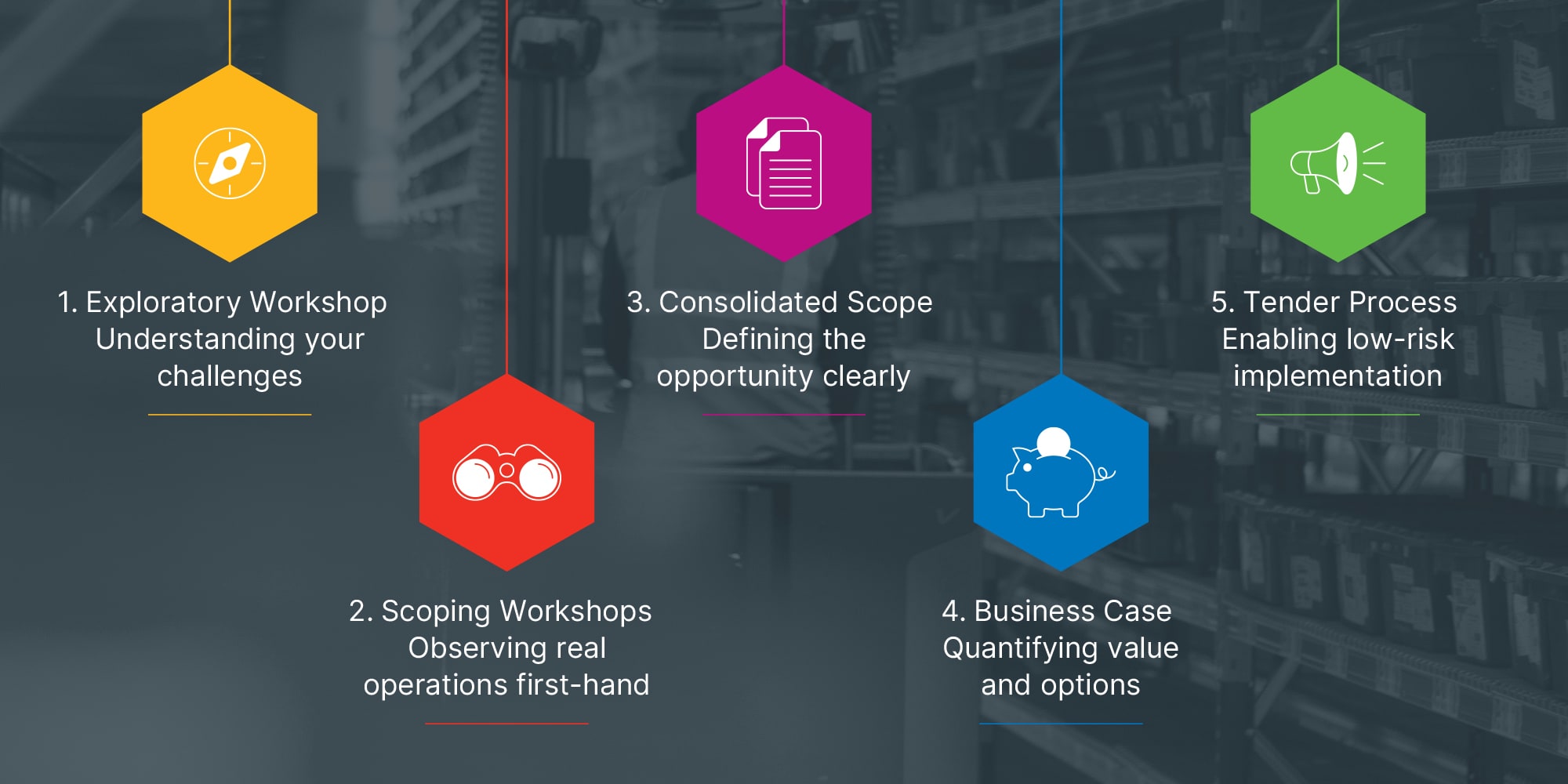
Our 5-step approach reflects this:
- Exploratory Workshop – understanding your challenges
- Scoping Workshops – observing real operations first-hand
- Consolidated Scope – defining the opportunity clearly
- Business Case Development – quantifying value and options
- Quote or Tender / Pilot – enabling low-risk implementation
At every stage, you remain in control.
And at every stage, the focus is on clarity.
Why Leaders Come to Us
The leaders we work with are not looking for a generic solution.
They are often in roles where:
- They can see inefficiencies
- They feel operational friction
- They know things could be better
But:
- The problem is not clearly defined
- The boundaries are blurred
- The starting point is unclear
That is the gap we fill.
Making the Complex Simple
“Ugly logistics” is not a failure.
It is a reflection of how complex, fast-moving organisations evolve over time.
Our role is not to criticise it.
It is to understand it.
To break it down.
To make it visible.
And to provide a clear, structured path forward.
Because once you can see it—
you can fix it.
And that is where real transformation begins.